:focal(smart))
Pixi supports RISC-V

As the RISC-V ecosystem matures from silicon to software, one piece has been missing: a modern, cross-platform package manager that makes it as easy to develop on RISC-V as on x86 or ARM. That has changed: Pixi natively supports RISC-V (riscv64), bringing the full power of the our package manager to open hardware.
RISC-V is happening
RISC-V is no longer a research curiosity. With the European Union committing €270 million through the EuroHPC Joint Undertaking to build a self-sustaining RISC-V ecosystem, and the European Processor Initiative delivering Europe's first out-of-order RISC-V processor, the hardware side is accelerating fast. But hardware without a software ecosystem is just sand and copper.
For developers targeting RISC-V in embedded systems, HPC, or edge computing the tooling story has traditionally meant cross-compiling from x86 and hoping for the best. With Pixi on RISC-V, you get the same workflow you already use on every other platform: declarative environments, a lockfile, and access to the conda-forge package repository natively, on your RISC-V board.
Running Pixi on RISC-V
RISC-V support in Pixi landed a while ago in version 0.46.0. The work involved adding a native riscv64 trampoline binary and ensuring the full rattler solver stack handles the linux-riscv64 platform correctly. Community contributors kxxt and Hofer-Julian drove the initial implementation, and we merged additional changes across rattler to make the platform a first-class citizen.
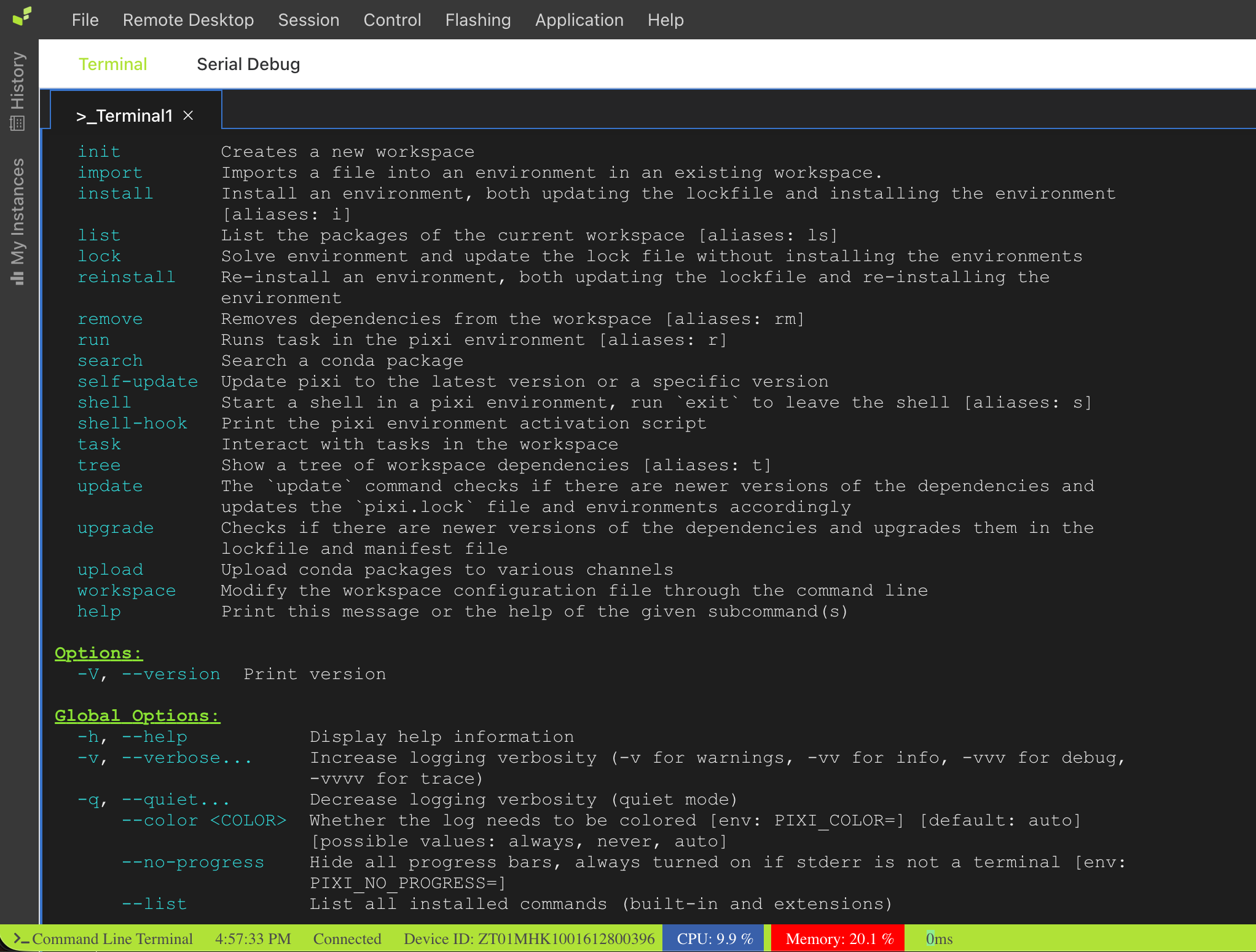
The following screenshot shows Pixi running on one of the first SpacemiT K3 RISC-V CPU with RVA23 on a VM in China.
The Broader Ecosystem Is Moving
We're not the only ones building toward this in the Conda ecosystem. The openKylin community from China, an open-source Linux distribution with a dedicated RISC-V SIG, has independently ported Conda and Mamba to RISC-V and built an experimental linux-riscv64 package channel based on conda-forge.
The openKylin channel serves as a great prototype for broader RISC-V support in conda-forge. It already contains GCC 14.3 and 15.2 for cross-compiling from linux-64 to linux-riscv64 as well as a RISC-V native GCC. Additionally, we also get Clang and Rust cross-compilers targeting RISC-V. OpenKylin also already has a few packages, such as Python 3.10 to 3.14, Conda, and Mamba (which you don't need if you use Pixi).
Available packages on RISC-V in openKylin: https://conda.openkylin.top/linux-riscv64/
Packages on Linux-64 for cross-compilation, offered by openKylin: https://conda.openkylin.top/linux-64/
The openKylin RISC-V SIG is now collaborating with the conda-forge community to push these packages into the official upstream repositories, with full RVA23 specification support targeted within the coming months. This makes the conda ecosystem work natively on RISC-V, a signal that this platform is getting ready for real workloads.
Getting Started with Pixi on RISC-V
Install Pixi on your RISC-V machine:
curl -fsSL https://pixi.sh/install.sh | bash
To use packages from the openKylin experimental RISC-V channel alongside conda-forge, add it as a channel in your pixi.toml:
[workspace]
name = "my-riscv-project"
channels = ["https://conda.openkylin.top/", "conda-forge"]
platforms = ["linux-riscv64"]

[dependencies]
python = ">=3.12"
Then just run:
pixi install
pixi run python --version
If you want to use the GCC toolchain for native compilation on RISC-V:
[dependencies]
gcc = ">=14.3"
The same pixi.toml and pixi.lock workflow you use on x86 and ARM applies here. There are no new tools to learn, no special RISC-V incantations.
Cross compilation from x64 to RISC-V with pixi-build
You can easily wrap existing tools - or your own software - and build RISC-V conda packages out of them with pixi build. Just use pixi build --target-platform=linux-riscv64.
In the following screenshot we build libopus on Github Codespaces for linux-riscv64, using the experimtental meson build backend with Pixi:
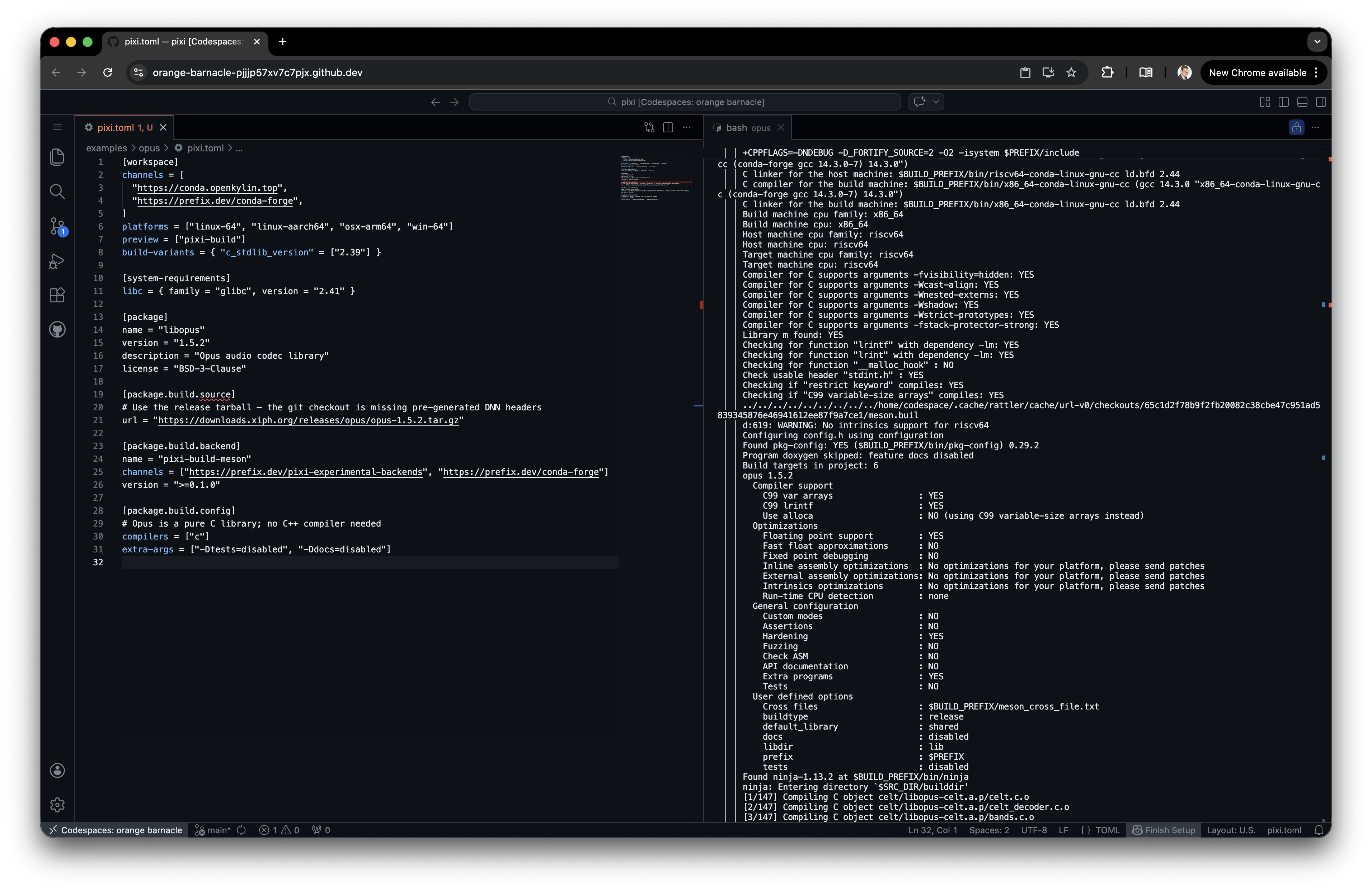 You can then grab the package and publish it on your own channel on prefix.dev! You can find the example
 pixi.toml file on Github.
Secure open source software for open hardware
When you use Pixi for your RISC-V package management, you get all of our supply chain security work "for free". Pixi supports sigstore for package signature verification, and that support extends to RISC-V. As institutions adopt RISC-V for sensitive workloads knowing that your packages are signed, verifiable, and tamper-evident isn't optional. With sigstore integration, every package you build and install with Pixi on RISC-V carries a cryptographic attestation of its origin. And there is more to come from us, in terms of software supplychain security.
At Prefix we want to make it easy to install and run the worlds open source software. The momentum around the RISC-V ISA excites us because it represents the same philosophy applied to hardware: open, collaborative, and free from licensing gatekeepers. Together, they form a stack that's open from the instruction set to the application layer.
We're building the open source infrastructure for European research institutions and companies investing in RISC-V as part of the EU's digital sovereignty strategy. Our powerful cross-platform package management layer will hopefully accelerate RISC-V adoption and offer a great way to get your software ready for RISC-V. Pixi can help, from development to deployment.
What's Next
We're working with the conda-forge community to expand riscv64 package coverage and improve package support for the platform.
We're also actively looking to collaborate with research institutions, universities, and organizations building on RISC-V. If you're working on RISC-V in a scientific computing, Robotics, HPC, or embedded context and need reliable package management, we'd love to talk. Just reach out at hi@prefix.dev or join our Discord.